Ashton’s Meadow, Treswell
"The best example of a species rich neutral grassland in Nottinghamshire."
- Nottinghamshire Wildlife Trust
Ashton's Meadow is an ancient meadow and you can still see ridges and furrows that were created by agricultural activity in the distant past. In the spring it has a spectacular display of cowslips and green-winged orchids. It is one of very few such meadows, not just in Nottinghamshire but the whole of the East Midlands and has been designated as a Site of Special Scientific Interest (SSSI).
Management of the site is by traditional methods - in recent times it has not been chemically treated nor ploughed. The sward is allowed to grow throughout the spring and early summer, before being cut for hay in July. During the late summer and autumn the re-growing grassland is kept fairly short by grazing, and before Christmas the animals are removed. This system maintains the rich flora and allows a range of butterflies and moths to flourish.
"Although small, Ashton's Meadow is one of the jewels in our estate of Nature Reserves. It was brought to our attention when a local schoolgirl told her teacher about the abundance of wild flowers to be found at the site. The teacher was an active member of Nottinghamshire Wildlife Trust and once aware of the site, the Trust decided it must do whatever it took to protect it for future generations."
- Charles Langtree, Head of Estate Management & Development, Nottinghamshire Wildlife Trust
Header image of Ashton's Meadow (above) © Adam Cormack.
Recipient Meadows
How to get there
Ashton’s Meadow is located 2km East of Treswell Wood in North Nottinghamshire. Visitors are asked to avoid trampling the hay crop (May to June), and disturbing grazing animals (August to February). The entrance at SK787800 can be reached from South Leverton, along Rampton Lane (0.7km). A second entrance is at the opposite end of Rampton Lane, at Catchwater Drain Bridge east of Treswell. A public footpath crosses the site, running north south, just inside the western boundary. For SatNav purposes use DN22 0BT and follow the directions above.
Species to spot
-
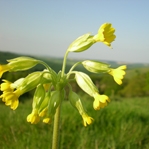
Cowslip
Best time to see: April - May
Easy to spot with its yellow cup-shaped flowers nodding at the end of tall stems. The name cowslip allegedly derives from ‘cowslup' - an old term for cowpat - since where the cow 'slupped' this flower was often found.
-

Green-winged orchid
Best time to see: May
The jester-like motley of its green and purple flowers gives this orchid its scientific name: morio, meaning 'fool'. It can sometimes be confused with the early-purple orchid but does not have spots on its leaves.
-

-
-

Hebridean sheep
A small breed which often grows two pairs of horns. Their wool is coarse and black, fading to brown in sunlight and grey with age. Able to thrive in rough grazing conditions, they are good choice for controlling scrub. Image © Adam Somerville/CC BY-SA